TL;DR
Real estate brokerage culture is not defined by office perks, happy hours, or mission statements written on a wall. It is revealed by what the people within an organization consistently do. A strong real estate brokerage culture gives agents opportunities to learn, collaborate, build relationships, develop as leaders, and support one another through every stage of their careers. At Keller Williams Houston Central (KWHC), culture shows up in local action—from top-producing agents stepping into leadership roles to community-wide efforts supporting causes like KW Cares.
What Should a Real Estate Agent Look for in Brokerage Culture?
Featured Snippet Direct Answer:
A strong real estate brokerage culture gives agents opportunities to learn, collaborate, build relationships, develop as leaders, and support one another beyond individual transactions. Agents evaluating a brokerage should look beyond social events and ask how the culture shows up through training, mentorship, accountability, leadership opportunities, community involvement, and the way people respond when someone needs help.
When evaluating a brokerage environment, real estate professionals often face glossy marketing campaigns promising a supportive community. However, true brokerage culture is operational. It is reflected in daily habits, peer access, and structural support systems.
Agents searching for a long-term professional home should evaluate six core cultural indicators:
- Peer Collaboration: Do experienced agents share strategies, market insights, and best practices, or do they operate in silos?
- Accessible Leadership: Are market center leaders and top producers approachable and actively engaged in helping others grow?
- Structured Development: Is there a clear pathway to progress from closing initial transactions to mastering business systems and stepping into leadership?
- Active Accountability: Does the brokerage offer peer-led or leadership-driven accountability to help agents stay aligned with their production goals?
- Community Involvement: Are there structured opportunities for agents to give back locally and support colleagues in times of need?
- Inclusivity & Psychological Safety: Is the environment supportive of agents across different price points, business models, and experience levels?
Culture Isn’t What a Brokerage Says. It’s What People Do.
The central thesis of any authentic real estate organization is simple: Real estate brokerage culture is not what an office says; it is what the people consistently do.
Mission statements printed on wall graphics do not assist an agent facing a challenging contract negotiation, nor do they help a newly licensed agent structure their lead generation workflow. Culture becomes visible through concrete behaviors:
- How agents treat one another when competition is high.
- Who steps up to lead volunteer committees and training sessions.
- Whether successful agents actively contribute to the growth of newer associates.
- How the market center responds when an agent or staff member experiences a sudden personal crisis.
- Whether leadership maintains an open-door policy during market shifts.
At Keller Williams Houston Central, culture is treated as an active discipline rather than a passive environment. It is built through daily interactions, structured committee work, shared educational experiences, and collaborative community service.
Culture in Action: The KWHC KW Cares Brunch
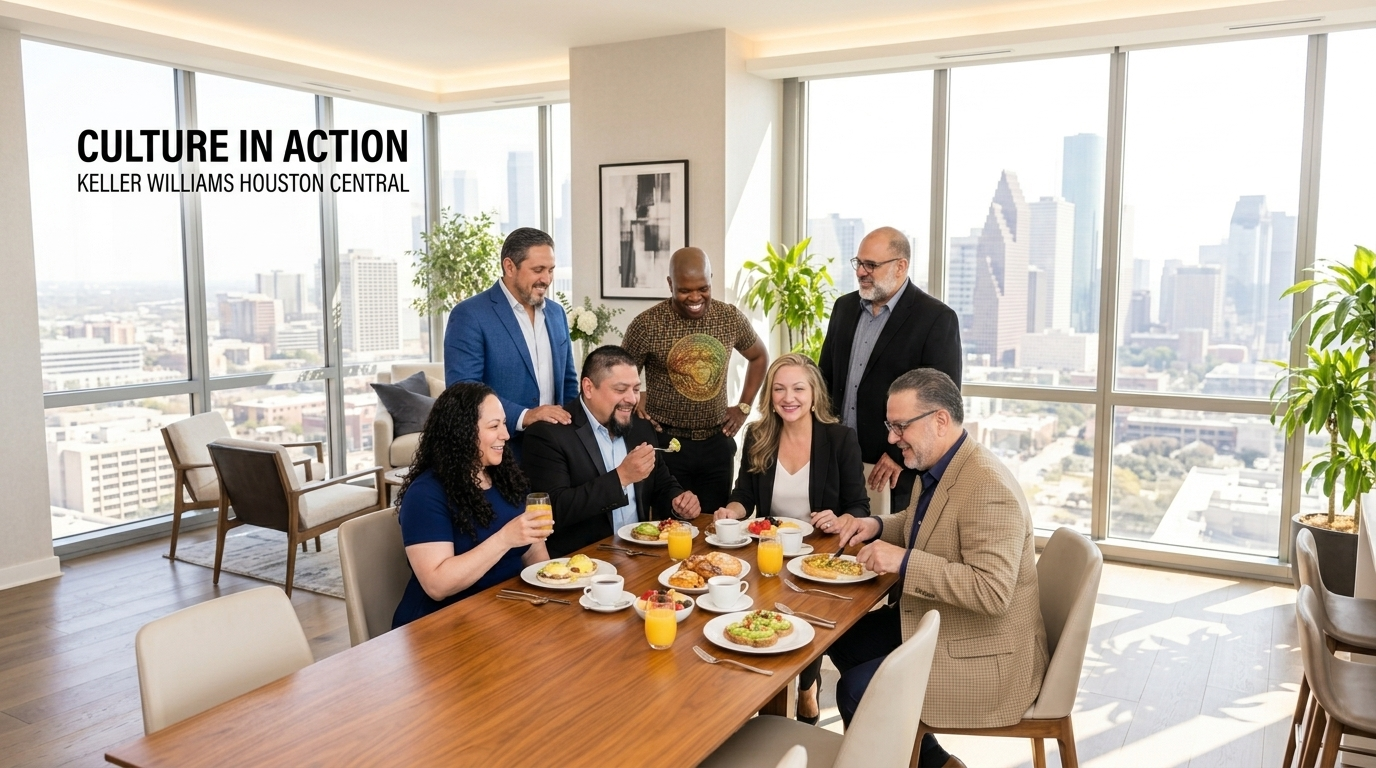
A recent example of culture in action at Keller Williams Houston Central was a brunch spearheaded by the KWHC Agent Leadership Council (ALC) Culture Committee in support of KW Cares.
The event brought agents together across all production levels around shared values of connection, service, community, and leadership. Rather than operating purely as a networking event, the brunch was designed to raise awareness and support for the charitable arm of Keller Williams, highlighting the brokerage’s broader mission to support associates during unforeseen hardships.
Events like this demonstrate how a market center can create spaces where professional relationships flourish alongside philanthropic commitment. When top-producing agents and new associates gather with a shared purpose beyond closing transactions, it builds a cohesive environment where agents feel connected to something larger than their individual production goals.
What Is KW Cares?
KW Cares is a public 501(c)(3) emergency grant charity created to support Keller Williams associates and their immediate dependent family members experiencing sudden financial hardship as a result of catastrophic circumstances.
Core Objectives & Impact
According to official KW Cares reports, the organization serves as a emergency safety net across the global Keller Williams family:
- Emergency Relief: Provides financial assistance to associates facing major illness, severe accidents, natural disasters, or unexpected personal tragedy.
- Historical Impact: Since its inception in 2003, KW Cares has awarded over $68 million in emergency grants and supported more than 7,400 associates and family members in times of need.
- Philanthropic Partnerships: KW Cares has also tithed over $7 million to affiliated non-profit partners supporting disaster relief and medical assistance programs nationwide.
By participating in local fundraisers like the KWHC Culture Committee Brunch, agents at Keller Williams Houston Central directly contribute to a system that ensures no associate has to face a severe life crisis entirely alone.
Top Producers Who Choose to Lead: Richard Moore & Raquel Forero
A strong indicator of a healthy brokerage culture is whether high-performing agents actively participate in the community or isolate themselves once they achieve success. At Keller Williams Houston Central, top producers frequently choose to invest their time and energy back into the market center.
Two prominent examples are Richard Moore and Raquel Forero, top-producing real estate professionals who serve as Co-Chairs of the KWHC ALC Culture Committee.
+-----------------------------------------------------------------------------------+
|                        THE AGENT DEVELOPMENT TRAJECTORY                           |
|                                                                                   |
|   [ LEARN ]  --->  [ PRODUCE ]  --->  [ SYSTEMIZE ]  --->  [ LEVERAGE ]  --->  [ LEAD ]   |
|                                                                                   |
|  At KWHC, agent growth does not end at production. Top producers like Richard      |
|  Moore and Raquel Forero exemplify how successful agents progress into leadership,  |
|  mentorship, and community contribution.                                          |
+-----------------------------------------------------------------------------------+
Rather than focusing exclusively on personal pipeline development, Richard and Raquel choose to co-chair the Culture Committee, leading initiatives that unite agents, drive community service, and foster a welcoming environment for all market center associates. Their participation reinforces a fundamental principle of KWHC’s agent development model: Success leads to contribution, which leads to leadership.
What Is the Keller Williams Agent Leadership Council (ALC)?
The Agent Leadership Council (ALC) is a core operational element of the Keller Williams business model, designed to give agents a direct voice in the leadership and direction of their local market center.
Structure and Function
- Agent-Led Governance: The ALC is composed of top-producing agents within the market center who are aligned with the brokerage’s goals and culture.
- Advisory & Alignment: Working alongside market center leadership (such as the Operating Principal and Team Leader), the ALC participates in decisions regarding operational alignment, agent experience, training priorities, and community outreach.
- Specialized Committees: The ALC operates through targeted committees focused on critical areas of market center life, including:
- Culture & Community: Driving philanthropic efforts, social events, and community support (such as the KW Cares Brunch).
- Growth & Membership: Supporting agent onboarding, retention, and professional integration.
- Education & Production: Assisting in curriculum design, skill-building workshops, and peer mentorship.
- Financial & Operational Alignment: Reviewing market center standards and supporting environment health.
The ALC provides a structured avenue for productive agents to develop executive leadership skills, contribute to business strategy, and shape the environment in which they work.
Culture Isn’t Free Coffee
It is common for brokerages to emphasize superficial perks—a renovated lounge, complimentary coffee bars, or monthly social hours—as proof of a vibrant work environment. While comfortable facilities and casual gatherings are welcome amenities, they do not constitute professional culture.
+-----------------------------------------------+-----------------------------------------------+
|             PERKS (SURFACE LEVEL)             |            CULTURE (SYSTEMIC DEPTH)           |
+-----------------------------------------------+-----------------------------------------------+
| Free coffee and physical lounge amenities     | Accessible leadership during market shifts    |
| Monthly happy hours and social mixers         | Structured peer-to-peer training & masterminds|
| Mission statements printed on office walls    | Active participation of top producers in ALC  |
| Casual, unorganized networking gatherings     | Structured accountability for sales growth    |
| Standard recognition trophies                 | Emergency support via KW Cares initiatives    |
+-----------------------------------------------+-----------------------------------------------+
True culture is revealed under pressure:
- How does the office handle a changing interest rate environment?
- Do experienced agents step up to teach tactical strategies when market conditions shift?
- Is there an active system of accountability that keeps agents focused on lead generation activities?
When evaluating a brokerage, look past the espresso machine and inspect the underlying framework of support, peer involvement, and professional development.
Does Brokerage Culture Actually Matter for Real Estate Agents?
Yes. Academic and organizational research across professional industries consistently demonstrates that workplace environment directly impacts individual performance, skill acquisition, and long-term retention. In independent-contractor sales environments like residential real estate, culture plays an even higher-value role due to the isolated nature of lead generation and client representation.
Key mechanisms through which culture impacts agent trajectory include:
- Social Learning & Skill Acquisition: Research in organizational behavior shows that peer proximity accelerates learning. When newer agents work alongside top producers in masterminds or training rooms, tactical skills are transferred far faster than through solo digital learning.
- Accountability Systems: Unstructured freedom can lead to inconsistent activity. At KWHC, leadership tag-teams agent accountability, such as Danielle Durocher and Garrett Hall leading structured accountability sessions. Knowing that peers and leaders regularly ask, “What did you commit to doing, and what got in the way?” helps agents maintain consistency.
- Psychological Resilience: Real estate markets fluctuate, and transaction friction is continuous. A supportive professional community provides the emotional and strategic grounding necessary to navigate challenging negotiations, lost listings, or broader economic shifts without burnout.
What Happens When Productive Agents Become Leaders?
When top producers step into leadership roles within a market center, the entire professional ecosystem elevates. Rather than viewing real estate as a zero-sum competition, leadership-minded top producers recognize that an active, highly skilled office increases brand reputation and transaction volume for everyone.
Productive agents contribute to leadership at KWHC through multiple pathways:
- Teaching & Workshop Delivery: Leading tactical sessions on negotiation, market statistics, or contract mechanics (e.g., KWHC’s Real World Real Estate series).
- Masterminds & Business Consulting: Sharing actual business systems, tech stacks, and database strategies with peers aiming for similar production brackets.
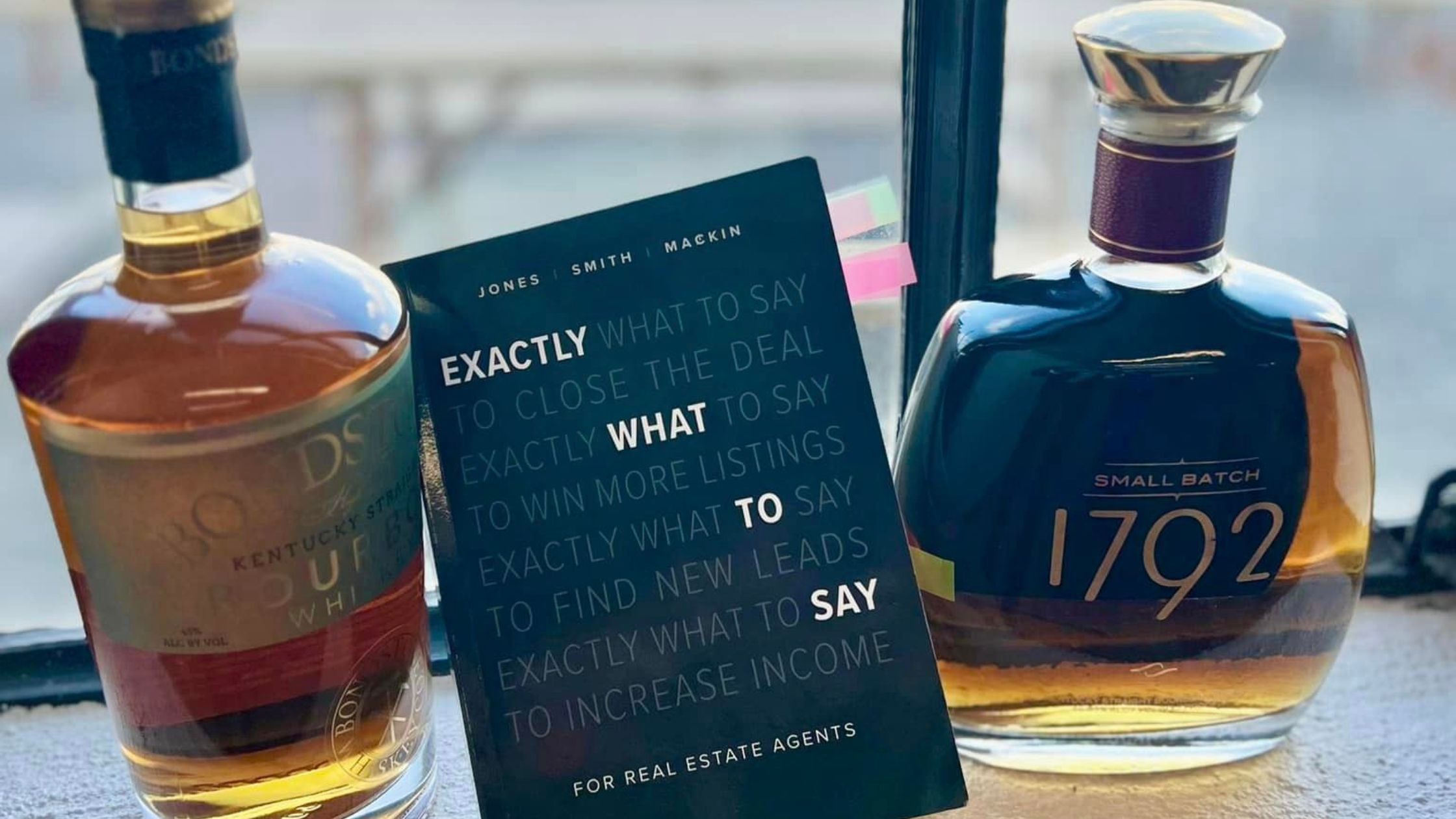
- Specialized Interest Groups: Leading book clubs and high-level discussions (such as Books & Bourbon) that focus on personal growth, mindset, and business management.
- Committee Leadership: Directing market center efforts via the ALC, as demonstrated by Richard Moore and Raquel Forero with the Culture Committee.
Importantly, leadership within Keller Williams does not require an agent to build a formal mega-team. Agents can remain solo practitioners while serving as influential leaders, mentors, and committee chairs across the local industry.
Culture + Agent Development: The Five-Stage Growth Path
Agent development should never plateau after an agent masters basic contracts and lead generation. Keller Williams Houston Central views agent growth as an ongoing evolution:
- LEARN: Mastering foundational skills—contracts, scripts, lead generation, compliance, and local market analysis.
- PRODUCE: Consistently generating leads, securing listings, writing buyer offers, and achieving stable transaction volume.
- SYSTEMIZE: Implementing operational workflows, CRM automation, administrative support, and repeatable client experiences.
- LEVERAGE: Expanding capacity through leverage—whether hiring talent, adopting AI tools, or forming teams.
- LEAD: Expanding influence beyond personal production by teaching, joining the ALC, mentoring, and driving market center culture.
By maintaining pathways for agents at every stage of this framework, KWHC ensures that both newly licensed agents and veteran top producers find relevant growth opportunities under one roof.
How KWHC Creates Opportunities for Agents to Connect and Grow
Keller Williams Houston Central bridges national KW models with local Houston execution through specific, structured programs designed to cultivate community and professional competence:
- Real World Real Estate: Practical, field-tested training led by experienced agents addressing real-time market conditions in Houston.
- Books & Bourbon: A peer-led discussion series focusing on business literature, personal finance, mindset, and strategic leadership in a relaxed environment.
- Mastermind Sessions: Role-specific collaborations (listing specialists, buyer agents, team leads) focused on tactical problem-solving and market trends.
- Agent Celebrations & Recognition: Regular recognition of production milestones, service contributions, and peer support achievements.
- Tag-Teamed Accountability: Guided accountability sessions designed to help agents stick to lead generation schedules and business plan goals.
These initiatives are designed not as passive social dates, but as active tools that help agents build relationships, sharpen business acumen, and remain accountable to their professional goals.
What Should Experienced Agents Look for in Brokerage Culture?
Experienced real estate professionals frequently fall into the trap of assuming that brokerage culture is only relevant to brand-new agents who require basic training. However, veteran agents and top producers often have distinct, sophisticated cultural needs:
- Peer-Level Collaboration: Access to masterminds composed of equal-producing peers who discuss wealth building, expansion systems, and high-level tax or team strategies.
- Advanced Technology & AI Integration: A culture that proactively tests, adopts, and shares training on modern tools, automation, and AI search visibility.
- Leadership Opportunities: Outlets to give back, influence market center decisions, and mentor others without forfeiting their production focus.
- Commercial & Specialty Exposure: Cross-departmental connection with commercial real estate, luxury representation, and property management specialists.
- Business Consulting: Access to market center leadership for high-level business audits and growth consulting rather than basic operational support.
Culture for experienced agents is about preventing isolation, elevating business systems, and providing a platform for broader professional leadership.
What Should Houston Real Estate Agents Look for in a Brokerage Community?
The Greater Houston metropolitan area is one of the largest, most diverse real estate markets in North America. Real estate professionals operating in Houston face unique local dynamics:
- Geographic Spread: Agents routinely navigate transactions spanning Downtown Houston, the Heights, Montrose, River Oaks, Katy, Sugar Land, The Woodlands, and the Inner Loop.
- Diverse Market Segments: From high-density downtown condominiums and historic inner-loop residential to suburban master-planned communities and commercial leases.
- Economic Variables: Navigating shifts driven by the energy sector, medical center expansion, corporate relocations, and evolving credit markets.
+-----------------------------------------------------------------------------------+
|                        HOUSTON METRO MARKET DIVERSITY                             |
|                                                                                   |
|  [ Downtown / Inner Loop ]   <--->   [ Suburban Master-Planned ]  <--->  [ Luxury ]   |
|   Condos, Townhomes, Infill           Katy, Sugar Land, Woodlands         River Oaks  |
|                                                                                   |
|  A central brokerage community connects agents across diverse geographic and      |
|  property-type specialties to share hyper-local market intelligence.               |
+-----------------------------------------------------------------------------------+
Because of this diversity, a Houston real estate agent needs a brokerage community that acts as a central hub. Based out of Downtown Houston (1201 Fannin St.), Keller Williams Houston Central offers agents a collaborative network where insights on hyper-local pricing, neighborhood-specific inventory, and vendor networks are continuously shared across price points and property types.
Questions to Ask About Culture Before Joining a Brokerage
If you are comparing real estate brokerages in Houston, do not rely solely on recruiting brochures or initial pitch meetings. Use this diagnostic checklist to evaluate the true culture of any market center:
- “Can I attend an active training session, mastermind, or team meeting before making my decision?”Why it matters: A transparent brokerage will gladly welcome you to observe real agent interactions and instructional quality.
- “Do top-producing agents actively attend meetings and teach classes here?”Why it matters: If top producers are invisible or operate entirely away from the office, peer-to-peer knowledge sharing is likely minimal.
- “What structured leadership opportunities exist for agents who aren’t team leaders?”Why it matters: Look for committees, ALC participation, and mentorship roles that allow solo agents to exercise leadership.
- “How does the brokerage handle accountability and goal setting throughout the year?”Why it matters: Uncover whether goal setting is a one-time January exercise or an active, ongoing system led by leadership and peers.
- “What specific initiatives does the office spearhead to support local charities or community needs?”Why it matters: Evaluates whether philanthropic values are actively practiced through programs like KW Cares or merely used as marketing copy.
- “Can I speak directly with three current agents who joined in the last 12 months?”Why it matters: Provides direct feedback on the onboarding experience, culture integration, and actual support received.
Frequently Asked Questions
FAQ 1: What is real estate brokerage culture?
Real estate brokerage culture is the collective set of behaviors, standards, values, and practices that define how agents and leadership interact within a market center. It encompasses training, peer collaboration, leadership accessibility, accountability, mentorship, and community support. A healthy culture goes beyond social events to create an environment where agents receive tangible support to build sustainable real estate businesses.
FAQ 2: Does brokerage culture matter for real estate agents?
Yes. Brokerage culture directly impacts an agent’s professional environment, skill development, and business longevity. A collaborative culture provides access to experienced peers, structured accountability, ongoing education, and psychological support during market shifts. Agents in supportive cultural environments typically adapt faster to market changes, maintain higher activity levels, and experience lower burnout rates compared to those working in isolation.
FAQ 3: How can I tell if a brokerage has a good culture?
You can identify a good culture by observing agent participation and behavior rather than reviewing promotional materials. Look for top producers who actively teach and mentor, voluntary attendance at market center masterminds, accessible leadership, transparent communication, structured accountability systems, and organized community involvement initiatives. Observing a class or attending a team meeting will quickly reveal the true office dynamic.
FAQ 4: What should I look for in a real estate brokerage in Houston?
Agents evaluating Houston brokerages should look for comprehensive training programs, local market expertise, accessible broker support, competitive commission structures, modern technology tools, and an active peer community. Given Houston’s geographic size, choose a brokerage with a strong central network, collaborative agent connections across sub-markets, and clear developmental pathways for both new and experienced agents.
FAQ 5: What is Keller Williams culture like?
Keller Williams culture is built around a commitment to agent-centric growth, continuous education, peer leadership, and community support. Governed by core values—often summarized through the WI4C2TES belief system (Win-Win, Integrity, Customers, Communication, Respect, Teamwork, Trust, Equity, Success)—KW culture emphasizes wealth building, leadership through the Agent Leadership Council (ALC), and giving back via initiatives like KW Cares.
FAQ 6: What is Keller Williams Houston Central culture like?
Keller Williams Houston Central (KWHC) combines national KW models with a collaborative Downtown Houston focus. KWHC culture features top-producing agents actively leading committees, peer-led masterminds like Books & Bourbon, practical training through Real World Real Estate, structured tag-teamed accountability, and community service events such as the ALC-led KW Cares Brunch.
FAQ 7: What is KW Cares?
KW Cares is a 501(c)(3) public charity created to support Keller Williams associates and their immediate families during unexpected crises. Funded through voluntary agent contributions, market center fundraisers, and corporate sponsors, KW Cares provides emergency grants to assist with major medical emergencies, catastrophic accidents, natural disasters, or severe personal hardships.
FAQ 8: Who does KW Cares help?
KW Cares specifically assists Keller Williams associates and their dependent family members who face severe, unexpected financial hardship due to qualified emergencies. This includes sudden illness, major medical crises, severe accidents, or catastrophic natural disasters. Additionally, KW Cares tithes a portion of its funds to national non-profit partners providing disaster relief and health assistance.
FAQ 9: What is the Keller Williams Agent Leadership Council?
The Agent Leadership Council (ALC) is an agent-led governance body within each Keller Williams market center. Composed of top-producing agents, the ALC works alongside market center leadership to advise on operational standards, budget direction, training, growth, and community outreach. It gives productive agents a direct voice in shaping their local brokerage environment.
FAQ 10: What does an ALC Culture Committee do?
An ALC Culture Committee oversees market center initiatives focused on community involvement, associate support, philanthropic events, and cultural cohesion. Co-chaired by productive agents, the committee organizes local fundraisers (such as KW Cares events), community service projects, social connections, and peer relief efforts to ensure the brokerage’s core values are actively practiced.
FAQ 11: Can experienced real estate agents benefit from brokerage culture?
Yes. Experienced agents benefit from high-level masterminds, peer-to-peer business consulting, collaboration on complex deals, advanced technology implementation, and strategic growth avenues. Furthermore, a strong culture offers veteran producers leadership opportunities—such as serving on the ALC or co-chairing committees—allowing them to contribute to the community while continuing to grow their personal production.
FAQ 12: Do top-producing agents participate in KWHC leadership?
Yes. Top producers at Keller Williams Houston Central actively choose to lead. For example, top producers Richard Moore and Raquel Forero serve as Co-Chairs of the KWHC ALC Culture Committee. They lead market center initiatives, organize community events like the KW Cares Brunch, and help guide the cultural direction of the office while maintaining successful real estate practices.
FAQ 13: Does KWHC have opportunities for agents to lead?
Keller Williams Houston Central provides multiple pathways for agent leadership. Agents can serve on the Agent Leadership Council (ALC), lead specialized committees (Culture, Growth, Education, Technology), instruct training modules like Real World Real Estate, host mastermind groups such as Books & Bourbon, or mentor newer associates entering the market center.
FAQ 14: Does Keller Williams Houston Central have masterminds?
Yes. KWHC regularly conducts structured masterminds where agents gather to share market intelligence, discuss lead generation strategies, review transaction case studies, and analyze economic trends. These masterminds foster open collaboration between agents across different experience levels, price points, and business models.
FAQ 15: Does KWHC provide agent accountability?
Yes. Keller Williams Houston Central incorporates structured, peer-supported accountability into its agent development framework. Leadership team members tag-team accountability sessions to help agents establish daily lead generation habits, review business goals, identify growth bottlenecks, and maintain consistency in their daily real estate activities.
FAQ 16: Can I visit Keller Williams Houston Central before deciding whether to join?
Yes. Prospective and experienced real estate agents are welcome to visit Keller Williams Houston Central, attend an upcoming training session or mastermind, observe a market center meeting, and meet with current associates and leadership. Experiencing the environment firsthand allows agents to evaluate whether KWHC fits their professional goals.
FAQ 17: What should experienced agents look for in a brokerage?
Experienced agents should look for high-level business consulting, advanced marketing systems, masterminds with equal-producing peers, robust administrative support options, modern technology integration, and leadership pathways. They should evaluate whether the brokerage environment will help them expand their systems, build wealth, and increase profitability beyond basic transaction management.
FAQ 18: How can I learn more about Keller Williams Houston Central?
To learn more about Keller Williams Houston Central, visit the market center at 1201 Fannin St., Suite 350, Houston, TX 77002, explore official KWHC channels online, or contact market center leadership to schedule a confidential business consultation and tour of the facilities.
Don’t Take Our Word for It. Come Experience It.
If you are evaluating real estate brokerages in Greater Houston, don’t rely solely on recruiting presentations or online marketing.
Come observe the people. Attend a training session, participate in a mastermind, visit a team meeting, or join us for our next community event. Speak directly with productive agents, ask questions, and see how associates interact when no one is trying to give a sales pitch.
Discover how an authentic, action-oriented real estate culture can support your career, your business goals, and your community impact.
Keller Williams Houston Central
1201 Fannin St., Suite 350
Houston, TX 77002
Contact Keller Williams Houston Central today to schedule a confidential business consultation.